
Supreme Court Sides with Trump Administration in 6-3 Decision on Birthright Citizenship Order
In a landmark 6-3 ruling issued on June 27, 2025, the U.S. Supreme Court partially sided with the Trump administration, granting its request to limit the scope of nationwide injunctions blocking President Donald Trump’s controversial executive order on birthright citizenship. The decision, which split along ideological lines with the court’s conservative majority prevailing, does not resolve the constitutionality of the order itself but significantly curtails the power of lower federal courts to issue universal blocks on executive policies. This procedural victory opens the door for partial enforcement of the order in much of the country, sparking immediate backlash from civil rights advocates and Democratic lawmakers who warn of a “patchwork of citizenship rights” and an erosion of the rule of law.
The case stems from Executive Order 14,160, signed by Trump on his first day back in office, January 20, 2025. The order seeks to end automatic birthright citizenship for children born in the United States to non-citizen parents, particularly undocumented immigrants and temporary visa holders. Trump has long argued that the 14th Amendment’s Citizenship Clause—”All persons born or naturalized in the United States, and subject to the jurisdiction thereof, are citizens”—does not apply to children of non-citizens, a fringe interpretation rejected by most legal scholars and never tested in this way before. The order was set to take effect 30 days after issuance, but it faced swift legal challenges from immigrant rights groups, including the ACLU, and 22 Democratic-led states. Three federal district judges in Washington, Maryland, and Massachusetts issued nationwide injunctions, halting enforcement entirely while litigation proceeded.
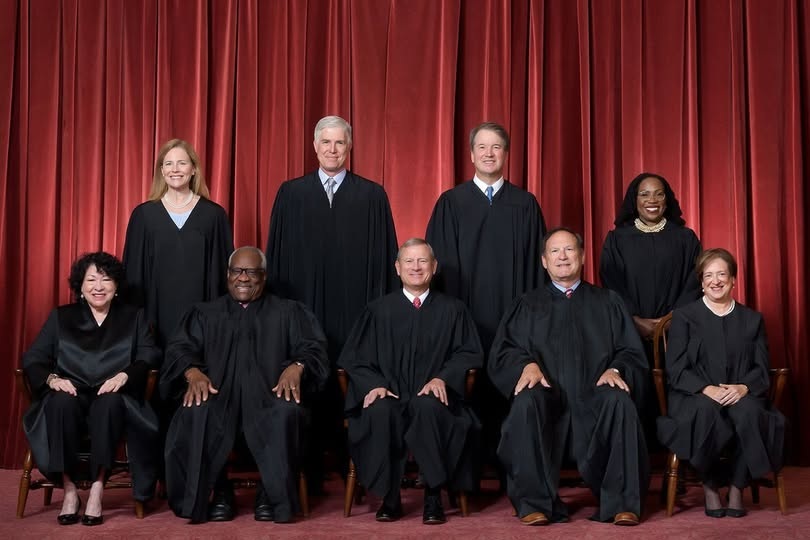
The Trump administration appealed to the Supreme Court not on the merits of the policy, but on the propriety of these “universal” or nationwide injunctions—a tool increasingly used by judges to block policies from both parties, but one conservatives have decried as judicial overreach and “judge shopping.” In a majority opinion authored by Justice Amy Coney Barrett, the court held that such injunctions likely exceed the equitable authority granted to federal courts by Congress. “Universal injunctions are not only inconsistent with historical equitable principles but also undermine the separation of powers by allowing a single district judge to halt national policy,” Barrett wrote, joined by Chief Justice John Roberts and Justices Clarence Thomas, Samuel Alito, Neil Gorsuch, and Brett Kavanaugh. The ruling narrows the injunctions to apply only to the plaintiffs in each case—meaning the order can proceed in the 28 states that did not sue, affecting an estimated hundreds of thousands of newborns annually.
The decision provides a 30-day stay from the date of the opinion, giving challengers time to pursue class-action lawsuits or state-specific relief. Justice Sonia Sotomayor, dissenting and joined by Justices Elena Kagan and Ketanji Brown Jackson, lambasted the majority for prioritizing procedure over substance. “This ruling invites chaos, allowing the Executive to flout the Constitution in vast swaths of the country while lawsuits crawl through the courts,” Sotomayor wrote, emphasizing that class actions remain viable for broad relief. Jackson, in a separate dissent, called it “an existential threat to the rule of law,” arguing that permitting partial enforcement of an allegedly unconstitutional order endangers vulnerable families.
President Trump hailed the outcome as a “monumental victory” during a White House press conference alongside Attorney General Pam Bondi, who predicted the court would soon address the order’s merits in its October 2025 term. “Americans are finally getting what they voted for—no more anchor babies exploiting our system,” Trump declared, echoing campaign rhetoric that galvanized his base. Bondi noted that implementation details, including enforcement by U.S. Citizenship and Immigration Services (USCIS), would be clarified soon, potentially involving heightened scrutiny of birth certificates and parental status.
Critics, including the ACLU and House Democrats, decried the ruling as a direct assault on the 14th Amendment, ratified in 1868 to ensure citizenship for freed slaves and their descendants. “This creates a nightmarish patchwork where a child’s citizenship depends on their parents’ zip code,” said ACLU legal director Cecillia Wang, vowing to escalate class-action challenges and appeals. Progressive groups fear it could lead to family separations, increased deportations, and confusion at hospitals, with estimates suggesting up to 4.7 million U.S.-born children could be affected over the next decade.
This is the second major 6-3 win for Trump this term, following a 2024 immunity ruling that shielded presidents from prosecution for official acts. Legal experts anticipate the full birthright citizenship debate could reach the court by fall, potentially reshaping American identity and immigration policy for generations. As the 30-day clock ticks, the nation braces for a contentious legal and political battle, with the fabric of citizenship hanging in the balance
